Android app
Production stations, lighting, alarm scenarios, and system functions are controlled via a mobile interface.
 LIONART3D
PROJECT STORY / CUSTOM DESIGN DIORAMA
A world built in the digital realm.
Every detail completed in the physical world.
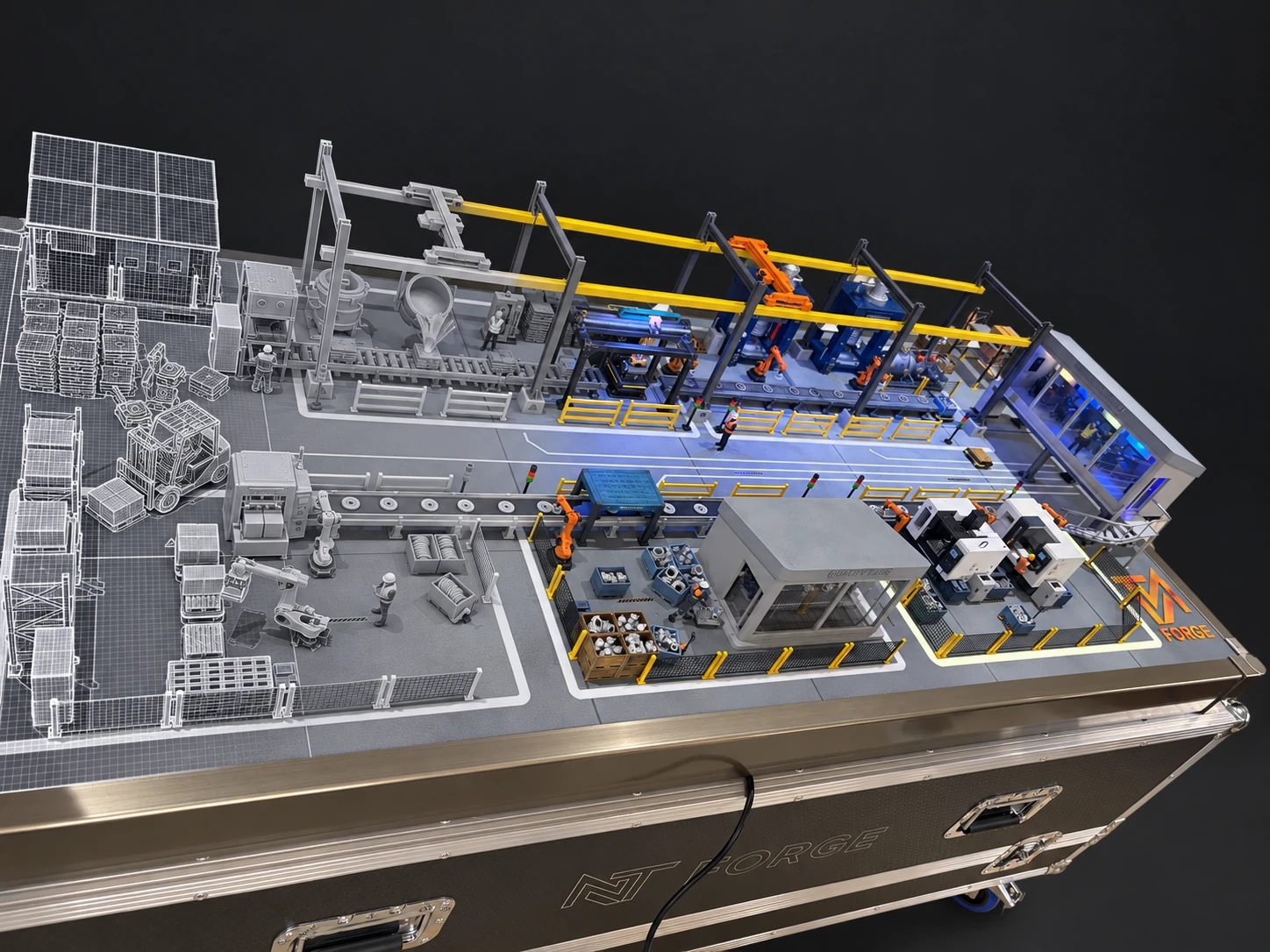
Bringing together a factory layout—machines, people, lighting, moving parts, and a digital control system—in an interactive diorama.
In TN Forge's work, digital layout, part modeling, Android application, microcontroller coding, 3D manufacturing, assembly, and surface finishing all come together in one system. The following content illustrates the process from on-screen design to software, to parts in the workshop, and to the finished model.
01 / CONCEPT
The first digital layout makes the relationships between production benchs, machine groups, and structures visible. Even before considering colors and surfaces, the overall layout of the model stands out.
02 / DESIGN
Yellow crane lines, machine bodies, roads, and small structures. Color, material, and lighting decisions become coherent in digital design.
03 / MODELING
A single component, like a casting pot, becomes a detail that carries the story of the model. The juxtaposition of the modeling screen and the printed part shows the physical equivalent of the digital work.
04 / PROTOTYPE & ASSEMBLY
In the unpainted laboratory's intermediate assembly, the interior space and equipment meet within the same volume. At this stage, digital lines are replaced by real surfaces, openings, and physical parts.
05 / SOFTWARE & CONTROL
The Android application and microcontroller code we developed for TN Forge transform the diorama's electronic functions into a manageable system. This turns the diorama from a mere visual object into a controllable experience.
Production stations, lighting, alarm scenarios, and system functions are controlled via a mobile interface.
The ESP32-based control board operates the light, sensors, and electronic components together according to the project's scenario.
Depending on the project's needs, we can add motorized details such as opening doors, rotating parts, or movable production components.
06 / PRODUCTION
Human figures, pipes, machines, and structural elements. Separately produced components are assembled in the workshop to create the physical world of the model.
07 / FINISHING
The figures and parts painted with airbrushing acquire a surface character. The light lines on the ground and the interior lighting of the structures make different aspects of the production world visible.
08 / FINAL PRODUCT
The casting line, robots, control tower, and laboratory. Design, software, electronic systems, physical components, and finishing touches all come together in a single project.
LOOK CLOSELY AT THE MODEL.
Real model footage recorded in the workshop.
56 seconds · Silent video
LET'S FIND A PHYSICAL REALITY FOR YOUR IDEA TOGETHER.
Let's transform a production process, a place, or a product
into a three-dimensional story.